
President Droupadi Murmu addressed both Houses of Parliament, highlighting the government's achievements in various sectors, including economic growth, social welfare, and infrastructure development. She emphasized the government's efforts to lift the economy out of "policy paralysis" and create a more inclusive society. Murmu also acknowledged the challenges posed by digital fraud and cybercrime and stressed the need for a social infrastructure revolution. The President's speech is considered a policy statement, outlining the government's vision and roadmap for the future.

The next firing is planned for Tuesday between 2 pm and 3 pm. it said.

Indian Space Research Organisation (ISRO) will conduct three more test vehicle missions under the ambitious Gaganyaan programme after the maiden TV-D1 test flight, which is scheduled on October 21, the space agency's chairman S Somanath has said.

On Sunday, July 30, 2023, the Indian Space Research Organisation successfully launched its proven Polar Satellite Launch Vehicle rocket carrying seven Singapore satellites from the Satish Dhawan Space Centre in Sriharikota and placed them into intended orbits.

The 25-hour countdown has begun for the launch of the Indian Space Research Organisation's PSLV-C53 mission in Sriharikota.

ISRO aims to send humans into space on a Low Earth Orbit of 400 km for a three-day mission and bring them safely back to earth.

ISRO chairman S Somanath said the success gave the space agency "greater confidence," as the GSLV will be next deployed in the NISAR mission, a collaborative effort with the US' NASA.

Only three countries (United States, Russia and China) have successfully landed spacecraft on the airless lunar surface.

On Friday, July 14, India launched its ambitious third lunar mission Chandrayaan 3, eyeing a rare feat in moon exploration.
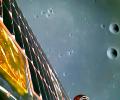
Taking to X (formerly Twitter), ISRO said, "Chandrayaan-3 Mission. Chandrayaan-3 Rover to MOX, ISTRAC, Moon walk begins!"

The Indian Space Research Organisation (ISRO) on Thursday announced that its lunar mission Chandrayaan-3 will be launched on July 14 from the space port at Sriharikota in Andhra Pradesh.

A single-stage liquid propulsion rocket, equipped with a Crew Module and Crew Escape System, is slated for a lift-off from the first launch pad at the spaceport here at 8 am on Saturday.

Scientists are working on conducting various tests for the ambitious Gaganyaan mission and the agency is coordinating with the Navy and others in this connection, he said.

The third and final test in the series of landing experiment (LEX-03) was conducted at 07:10 1ST at the Aeronautical Test Range in Chitradurga, Karnataka.
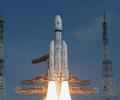
The test vehicle development flight (TV-D1) will be conducted at the Satish Dhawan Space Centre in Sriharikota in Andhra Pradesh to test the crew module that is scheduled to house Indian astronauts during the human spaceflight late next year.
He said the test vehicle is ready at Sriharikota and the assembly work of the crew module and crew escape system has also begun.

'With India's growing capabilities in the space sector, this creates promising opportunities for enhanced collaboration and market access.'
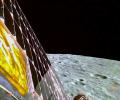
According to the Indian Situational Space Awareness Report for 2023, the nominal lift-off of the Launch Vehicle Mark-3, carrying the Chandrayaan-3 spacecraft, had to be delayed by four seconds based on the Collision on Launch Avoidance analysis.

Weighing 320 tonne at lift-off, the vehicle used larger strap-on motors to achieve higher payload capability.

'Today onwards, the onboard thrusters will be fired and Chandryaan-3 will be taken away from Earth for an eventful landing on Moon's surface on August 23'

AzaadiSAT had around 75 small payloads developed by schoolgirls of 75 rural schools.
The mission is targeted for launch in the fourth quarter of 2024.

The primary satellite TeLEOS-2 is a synthetic aperture radar satellite developed under partnership between Defence Science and Technology Agency (DSTA) representing the Government of Singapore and ST Engineering.

Four years after it broke many hearts, Indian Space Research Organisation's Chandrayaan is all set to soar towards the moon in its third expedition on Friday in an attempt to put the country in an elite club of nations that accomplished lunar missions with a soft landing.

ISRO's maiden solar mission, Aditya L1, has captured its first high energy X-ray glimpse of solar flares. During its first observation period from approximately October 29, the High Energy L1 Orbiting X-ray Spectrometer (HEL1OS) on board Aditya-L1 spacecraft has recorded the impulsive phase of solar flares, the space agency said in a statement on Tuesday.

The polar satellite launch vehicle's 52nd mission is scheduled for lift-off at 15.41 hours on Thursday from the second launch pad at the spaceport of Sriharikota 'subject to weather conditions'.

The Indian Space Research Organisation (ISRO) will perform the final manoeuvre on Saturday to inject Aditya-L1 spacecraft -- the first space-based Indian observatory to study the Sun -- into its final destination orbit, some 1.5 million kilometres from the Earth.

'ISRO's style is a terrific example of being able to survive, acknowledge failures, and then most importantly of all, learn from them to ensure that subsequent missions are successful.'

Once deployed and operational, it will be used to support the satellite imagery requirements of various agencies within the government of Singapore.

Shifting the focus to its next space odyssey after successfully placing a lander on the moon's uncharted South Pole region, the Indian Space Research Organisation (ISRO) chief S Somanath on Saturday said that the country's maiden solar mission Aditya-L1 is ready and will be launched in the first week of September.
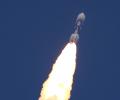
India's first solar mission, if successful, will showcase ISRO's ability to explore the cosmos, explains Kumar Abishek.

In this process, millions and millions of tons of solar materials are thrown into the interplanetary space, he said, adding these CMEs can travel at a speed of approximately 3,000 km per second.
Chandrayaan-1, India's first mission to the Moon, was launched on October 22, 2008 from Sriharikota spaceport in Andhra Pradesh.
The successful launch of the maiden solar mission of the Indian Space Research Organisation came on the heels of the historic lunar landing mission - Chandrayaan-3.
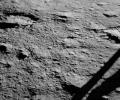
The lessons learned from the failure of Chandrayaan-2 contributed to the success of India's third lunar mission, former space scientist with the Indian Space Research Organisation (ISRO) Nambi Narayanan said, after the successful touchdown of the 'Vikram' lander on the lunar South Pole.

The ISRO on Sunday scripted yet another history after its LVM3 rocket successfully placed 36 satellites of United Kingdom-based OneWeb group company into intended orbits.

Aditya L1, the first space based Indian mission to study the Sun underwent the second earth-bound manoeuvre successfully, during the early hours on Tuesday, Indian Space Research Organisation (ISRO) said.

After the historic success of its Chandrayaan-3 lunar mission, Indian Space Research Organisation (ISRO) is going full throttle with its plans to send Indian astronauts for the first time to the Moon by 2040, ISRO Chairman S Somanath said.

Former National Aeronautics and Space Administration (NASA) Official Mike Gold has said Chandrayaan-3's success is a triumph of Indian innovation, human capital and the capabilities that will take India even further.

Here's a breakdown of how the series of events unfolded at the Satish Dhawan Space Centre at Sriharikota
